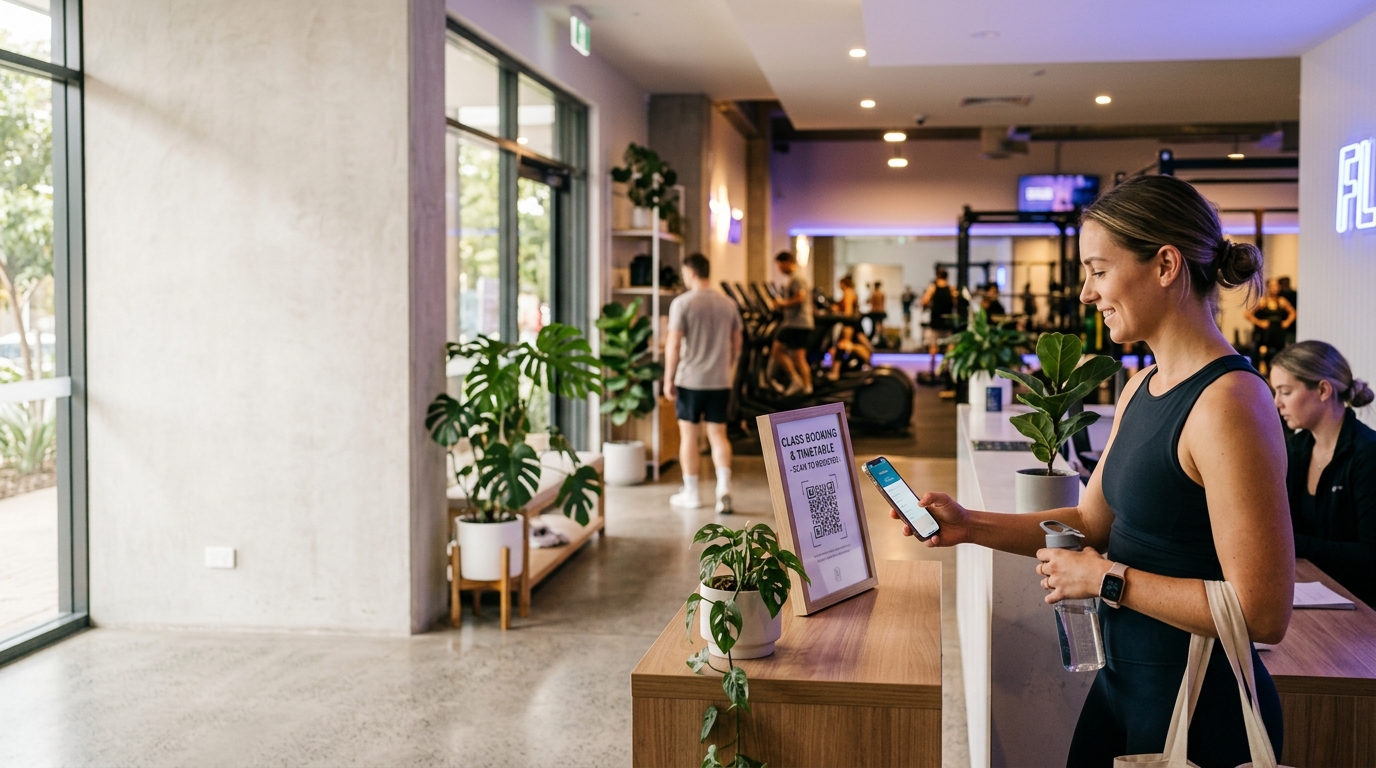
QR Codes for Gyms & Wellness Studios
Gyms, yoga studios, and personal trainers use QR codes to make admin disappear — members book classes, track attendance, and access workout plans without a single paper form.
Create your free QR code →Free trial · No credit card · Codes never expire
What you can do with QR codes in Gyms and Wellness Studios
The most common uses are:
Every QRecode code is dynamic — you can change where it points at any time without reprinting, and every scan is tracked.
Codes on gym equipment
The strongest use in a gym is putting a demonstration behind each machine. Members guess at form, plate loading and seat position, and a code on the frame linking to a thirty-second video answers the question at the moment it is being asked.
The environment is hostile to print, though. Equipment codes are touched with sweaty hands, wiped with alcohol-based cleaner several times a day, and sit in humid air. Paper labels fail within weeks. Use laminated vinyl or engraved plates, and position the code where a hand does not naturally rest — on the upright or the shroud rather than the grip area.
Size for someone standing at the machine, roughly 50cm to a metre, which means 5–10cm.
- Laminated vinyl or engraved plates — never paper.
- Position away from grips, pads and anywhere hands rest.
- 5–10cm for a standing read at the machine.
- Matte finish; gyms are brightly lit from above.
- Check them monthly — cleaning chemicals fade codes faster than sunlight.
Class timetables, bookings and the changing-room reality
Timetables are the other natural fit, because they change constantly and printing them is a recurring chore. A dynamic code on a wall poster can point at a live schedule that updates whenever a class moves.
Two practical notes. Signal in gyms is frequently poor — basements, thick walls, mirrors and steel — so the landing page must be light and fast, and a WiFi code near the entrance is worth more here than in most venues. And a code in the changing room will be scanned by people who are half-dressed and in a hurry, so put booking codes at the exit or by the water fountain instead, where people linger.
Sign-up, trials and measuring which poster worked
Gyms run continuous local marketing — leaflet drops, window posters, partner cafes, community boards — and almost never know which one produced a membership.
Giving each placement its own dynamic code turns that into data. Same design, different code per location, and the scan counts tell you which board, which street and which partner is actually generating trials. That is the argument for dynamic codes in fitness specifically: not the flexibility, but the attribution.
What to put behind a gym code, and what to avoid
The destination decides whether a gym code becomes habit or gets scanned once and forgotten.
Equipment codes should land on one short demonstration for that machine, not a video library. A member standing at a lat pulldown wants thirty seconds on seat height and grip, not a channel to browse. Class codes should land on a live timetable that reflects today, because a member who scans and finds last month's schedule will not scan again. Sign-up codes should land on a form, not a homepage with a form somewhere on it.
The pattern that fails is pointing everything at the gym's main website. It is the path of least resistance for whoever sets the codes up, and it wastes every scan, because a member has to navigate from a general page to the specific thing they were standing in front of.
- Equipment code — one short form video for that machine.
- Class board — a live timetable, not a PDF exported last term.
- PT area — a booking calendar with real availability.
- Exit and water fountain — reviews, referrals or challenge sign-ups.
- Reception — the WiFi code and the membership options.
A real, working QR code
This code was generated on this page, in your browser. Point your phone camera at it and it opens this guide — every code the generator makes works the same way.
Create yours freeHow to create a QR code
From idea to scannable code in three simple steps.
Create your code
Choose what your code links to — a website, menu, booking page, contact card or more. Customise the colours to match your brand.
Add it to your materials
Download a print-ready PNG or SVG and add it wherever your customers will see it. SVG stays sharp at any size.
Track and update
Watch scans roll in through real-time analytics, and change where your code points any time — no reprinting needed.
Why use dynamic QR codes?
Unlike static QR codes, dynamic codes let you change where they point any time — without reprinting. Track every scan with real-time analytics, customise the design to match your brand, and download in print-ready SVG or PNG.
- Reduce admin with direct booking links on the gym floor
- Track peak times and class popularity
- Members access resources on their phone mid-workout
Change where your code points without reprinting.
See every scan, device, and location instantly.
Match your brand colours and add a logo overlay.
Print-ready quality at any size.
UK-hosted, privacy-first scan tracking.
Your printed materials work forever.
Dynamic vs static QR codes
Not sure which to use? Here's how they compare.
Practical tips
Equipment codes meet sweat, chalk and alcohol cleaner several times a day. Paper labels fail within weeks.
Position on the upright or shroud rather than anywhere hands naturally rest and wipe.
A code in the changing room is scanned by people half-dressed and in a hurry. The water fountain and the exit work better.