A static QR code stores the destination inside the pattern itself, so it works without any server but can never be changed after printing. A dynamic QR code stores a short redirect instead, so the same printed code can be pointed somewhere new at any time, and every scan can be counted. Use static for information that will never change; use dynamic for anything you might want to edit or measure.
The mechanical difference
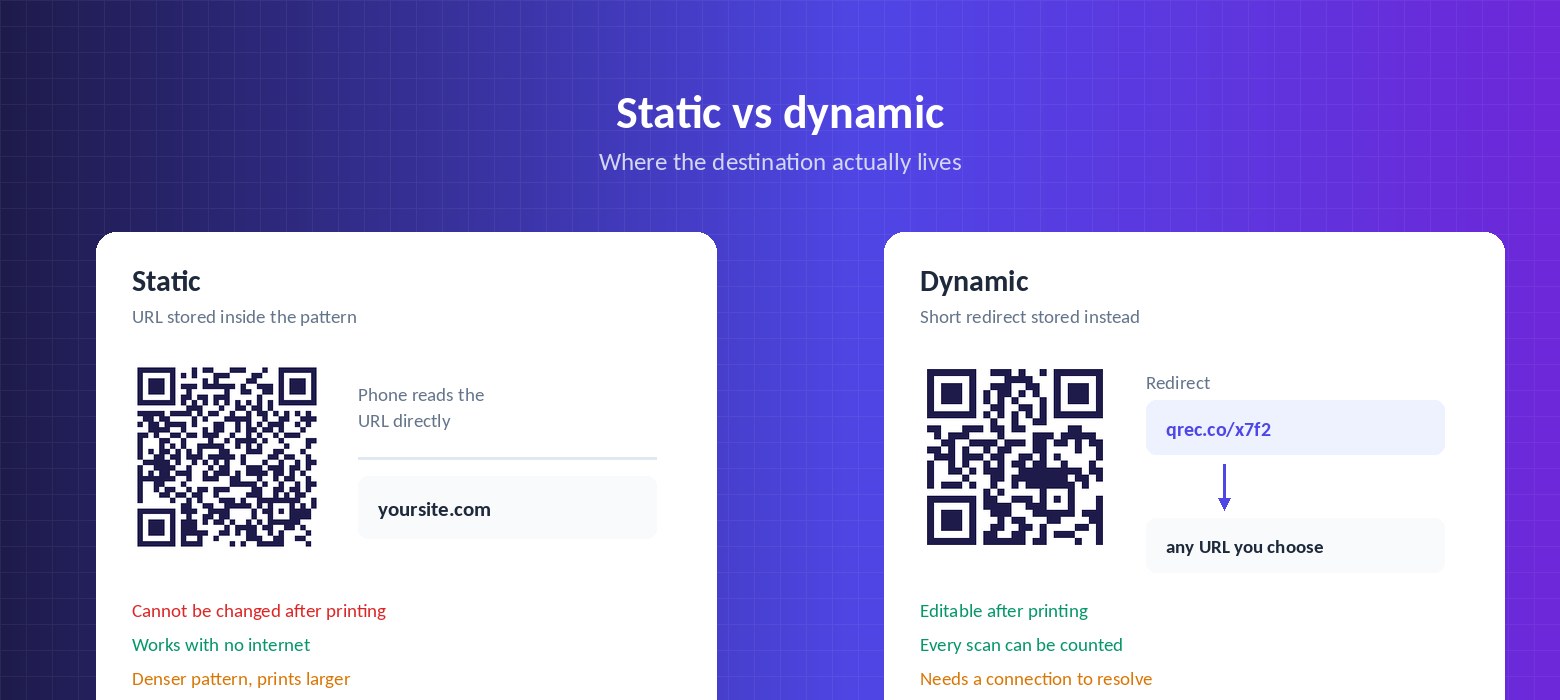
Both types look like a grid of black and white squares, and both are read the same way. The difference is what is written inside the pattern.
A static code contains the destination in full. If it points to a 90-character URL, all 90 characters are encoded in the squares, which is why longer URLs produce visibly denser codes that need to be printed larger.
A dynamic code contains a short redirect address instead — typically 20 to 25 characters regardless of where it ultimately leads. The pattern stays sparse and prints smaller, and the destination is looked up when someone scans.
Side by side
| Static | Dynamic | |
|---|---|---|
| Change destination after printing | No | Yes |
| Scan tracking | No | Yes |
| Works with no internet | Yes | No |
| Depends on a third party | No | Yes |
| Pattern density | Grows with URL length | Always short |
| Minimum print size | Larger for long URLs | Smaller |
| Typical cost | Free everywhere | Free tier, then paid at volume |
When static is the right answer
Static is not the lesser option. It is the correct choice whenever the content genuinely will not change and independence matters more than measurement.
- WiFi codes, which encode the network name and password directly and must work before a guest is online.
- vCard contact codes where the details are stable and you want the save to work with no signal.
- Plain text, phone numbers and SMS codes.
- Anything in a location with unreliable connectivity — rural signage, basements, aircraft, underground venues.
- Anything you need to be certain will still work in twenty years with no provider involved.
When dynamic earns its keep
Dynamic is worth the dependency whenever the destination might change, or you want to know whether anyone is scanning.
- Menus, price lists and anything seasonal.
- Packaging, where the print run is large and the campaign behind it is not.
- Business cards, so a job change does not invalidate a box of 500.
- Marketing campaigns you need to measure and compare.
- Anything where you want to point the same printed code at different content over time.
A practical rule
Ask one question: if I needed to change where this points next month, what would it cost me?
If the answer is "nothing, I would just regenerate it" — static is fine. If the answer involves reprinting anything at all, or reprinting something already in customers' hands, use dynamic. The cost of being wrong is asymmetric: a dynamic code you never edit has cost you nothing, whereas a static code you need to change costs you the entire print run.
Create a QR code free
Dynamic codes you can edit after printing, with scan tracking. No card needed.
Open the generator